The Grease-Stained Pamphlet That Taught America How to Read a Manual
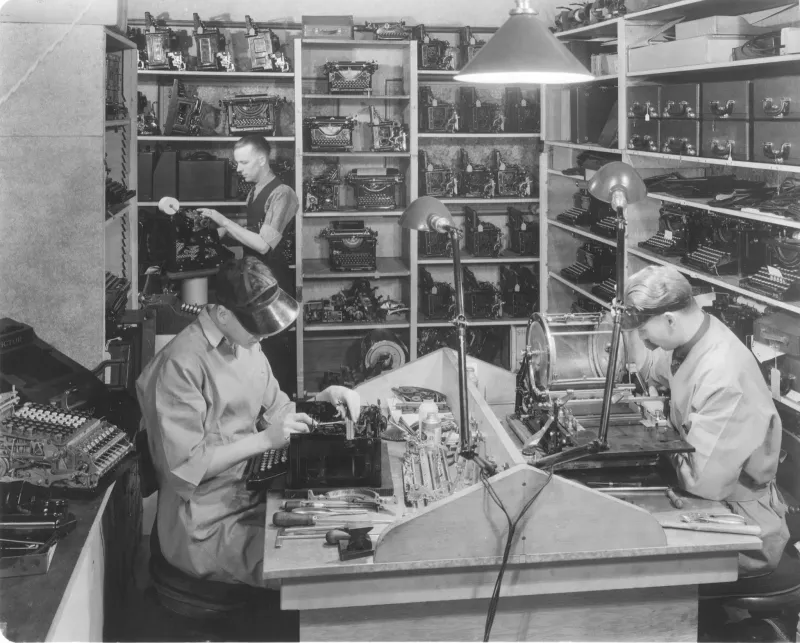
Photo: vintage typewriter repair shop 1920s mechanic workshop, via blogger.googleusercontent.com
Nobody Came With Instructions
Think about the last time you assembled furniture, set up a new phone, or tried to figure out why your dishwasher was making that noise. Somewhere nearby, probably stuffed in a drawer or pulled up on your screen, there was a manual. Step one. Step two. Diagrams with little arrows pointing at things. It felt obvious, almost boring.
But for most of American consumer history, that document didn't exist. Products arrived in your home and you were more or less on your own.
The story of how that changed begins not in a corporate boardroom or a marketing department, but in a small repair shop in Chicago, sometime around 1923, with a man named Gerald Hooper and a typewriter that was driving him absolutely crazy.
The Machine Nobody Could Fix Twice the Same Way
Hooper worked as a field technician for a regional office equipment distributor during the early years of the typewriter boom. By the early 1920s, typewriters were everywhere — law offices, newspaper rooms, insurance companies, government buildings. And they broke constantly.
The problem wasn't that the machines were poorly made. The problem was that every repair technician had learned on the job, passing down fixes by word of mouth. One guy knew a trick for the carriage return. Another had figured out the tension on the ribbon feed. But none of it was written down. When a new technician came on, he basically started from scratch.
Hooper, by his own account in a 1947 trade magazine interview, got fed up after a particularly bad week in which he watched two colleagues spend three days diagnosing a problem he could have fixed in forty minutes — if only they'd known what he knew.
So he wrote it down.
Over several weekends, he produced what he called a "service reference" — a thirty-eight-page document breaking down the most common typewriter faults, organized by symptom, with hand-drawn diagrams showing exactly where to look and what to do. He made a few carbon copies and handed them out to colleagues.
From Shop Floor to Showroom Floor
What happened next was the part nobody expected.
One of those carbon copies made its way to the distributor's sales office. A manager there, trying to close a deal with a skeptical business owner who worried about maintenance costs, showed the document to the customer as a kind of reassurance. Look, we even have documentation. You'll always know how to keep this running.
The customer was impressed. He bought two machines.
Word traveled. Within a year, the distributor was including simplified versions of Hooper's guide with every sale. They weren't calling it a manual yet — the terminology hadn't caught on — but that's exactly what it was. And customers, it turned out, loved it.
This was a genuinely radical idea at the time. The prevailing attitude among manufacturers was that explaining how a product worked would either overwhelm buyers or, worse, encourage them to tinker and break things. Products were supposed to be operated, not understood.
Hooper's little pamphlet quietly proved that assumption wrong.
The Manufacturers Take Notice
By the late 1920s, a handful of larger typewriter and office equipment companies had started producing their own documentation. Underwood, Remington, and Royal all began including basic user guides with commercial models. The content was thin at first — mostly warnings and basic maintenance tips — but the format was unmistakably descended from what Hooper had pioneered.
The real acceleration came after World War II, when American consumer culture exploded. Washing machines, refrigerators, televisions, power tools, hi-fi systems — suddenly the average household was filling up with complex mechanical and electrical products that the average person had never encountered before.
Manufacturers faced a choice: train a massive network of service technicians to handle every question, or give customers enough information to handle things themselves. The instruction manual, it turned out, was far cheaper.
By the 1950s, the manual had become a standard part of the product package. By the 1960s, consumer advocacy groups were arguing that clear, readable documentation was a right, not a courtesy. Ralph Nader's broader consumer safety movement pushed the idea further — that companies had a responsibility to communicate clearly about how their products worked and what could go wrong.
IKEA and the Visual Revolution
The next major evolution came from an unexpected direction: furniture.
When IKEA began expanding into the US market in the 1980s, they brought with them a manual format that had been refined for a global audience — wordless, diagram-driven, built entirely around visual logic. No language barrier. No assumptions about what the reader already knew. Just numbered steps and clean drawings.
American consumers, who had grown up with increasingly dense and jargon-heavy manuals, found it almost refreshing. The IKEA format became a cultural touchstone, and its influence spread far beyond furniture. Tech companies, appliance brands, and toy manufacturers all began rethinking how they communicated assembly and setup.
Today the instruction manual has moved almost entirely online — QR codes, video tutorials, searchable knowledge bases. But the core idea, the radical notion that a customer deserves a clear explanation of what they just bought, traces back to that grease-stained carbon copy from a Chicago repair shop a century ago.
The Thing We Forgot to Credit
Gerald Hooper never got rich off his idea. He spent his career as a field technician and retired quietly in the late 1950s. He's not in any business hall of fame. There's no patent with his name on it.
But the next time you flip open a quick-start guide, squint at an assembly diagram, or pull up a how-to video because the written instructions weren't clear enough — you're living inside an industry that exists because one technician decided his colleagues deserved better than guesswork.
Sometimes the most durable inventions aren't machines or formulas. Sometimes they're just a better way of explaining things.