How the Meatpacking Industry Convinced America That Bacon Was a Morning Food
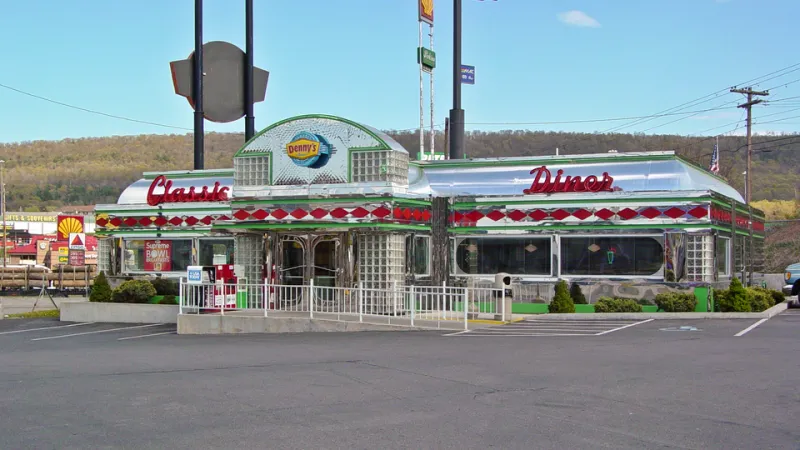
Photo: Ben Schumin, CC BY-SA 2.0, via Wikimedia Commons
Order breakfast for dinner at any diner in America and the server won't blink. Pancakes at 9 p.m., scrambled eggs at midnight, bacon at any hour you feel like it—Americans treat the morning meal with a kind of nostalgic reverence that crosses all time boundaries. We call it comfort food. We call it a classic. What we rarely call it is what it actually was: a marketing campaign.
What Americans Actually Ate Before Bacon and Eggs
For most of the 19th century, the American breakfast was a considerably lighter affair than the spread we now consider traditional. Working-class families might eat leftover bread, porridge, or whatever was available. Middle-class households favored lighter fare—toast, fruit, maybe a soft-boiled egg. The idea that a proper morning required a full protein-and-fat production was not yet part of the national identity.
In fact, the early 20th century was trending in the opposite direction. Health reformers like John Harvey Kellogg—yes, the cereal Kellogg—were loudly advocating for lighter, grain-based mornings. Cold cereal was positioned as the modern, scientific alternative to heavy meat-and-fat breakfasts. Kellogg's Battle Creek Sanitarium in Michigan was churning out dietary philosophy alongside cornflakes, and the message was gaining traction: eat light in the morning, save your digestion.
The meatpacking industry was watching this trend with considerable alarm.
Enter Edward Bernays
Edward Bernays is one of the more consequential figures in American commercial history, and also one of the least household-name-famous. A nephew of Sigmund Freud, Bernays essentially invented the modern public relations industry—the art of shaping public opinion not through direct advertising, but through manufactured consensus.
In the early 1920s, Beech-Nut Packing Company, a major producer of bacon among other products, hired Bernays to help boost flagging bacon sales. The light-breakfast movement was cutting into their business, and they needed a counteroffensive.
Bernays didn't take out ads. He didn't run promotions. Instead, he went to a physician—his own doctor, according to most accounts—and asked a simple question: is a hearty breakfast better for you than a light one? The doctor agreed that, yes, the body burns more energy in the day than at night, and a substantial morning meal made physiological sense.
Bernays then sent that question—and the doctor's answer—to thousands of physicians across the country, asking them to weigh in. The vast majority agreed with the premise. He then released the results as a news story: thousands of doctors recommend a hearty breakfast. The campaign didn't mention bacon by name. It didn't have to.
Newspapers picked up the story. The idea that a substantial breakfast was medically endorsed filtered into the cultural mainstream. And when Americans thought about what a hearty breakfast looked like, Beech-Nut's product was conveniently positioned as the obvious answer. Bacon and eggs became the default image of a proper American morning.
How a Marketing Move Became a Cultural Cornerstone
What Bernays understood—and what makes this story genuinely surprising—is that he wasn't selling bacon. He was selling a belief about mornings. Once that belief was in place, the bacon sold itself.
Over the following decades, the hearty American breakfast became self-reinforcing. Diners built their menus around it. Home economics curricula taught it as nutritional common sense. Advertisers for eggs, orange juice, butter, and coffee all built on the same platform, each one deepening the cultural groove. By mid-century, bacon and eggs wasn't a marketing construct anymore—it was simply what Americans ate in the morning.
The postwar diner culture cemented it further. Returning veterans, suburban expansion, and the rise of roadside restaurants all normalized the full breakfast plate as an American institution. By the 1960s, you could drive from Maine to California and find the same spread waiting for you: two eggs any style, bacon or sausage, toast, hash browns, coffee.
The irony is that this manufactured tradition became so deeply embedded that it eventually transcended its original time slot entirely. Waffle House built an empire on round-the-clock breakfast. IHOP—the International House of Pancakes—turned all-day breakfast into a brand identity. McDonald's launched its breakfast menu in 1975 and eventually extended it to 24 hours under customer pressure. Americans didn't just adopt the hearty breakfast—they freed it from the morning entirely.
Breakfast for Dinner as a Cultural Full Circle
When Americans order breakfast for dinner today—a habit so common it has its own term, "brinner" in some circles—they're participating in something layered with unintentional meaning. The meal they're treating as nostalgic comfort food was itself a constructed nostalgia, an image of wholesome American mornings engineered in a publicist's office a hundred years ago.
None of that makes the bacon taste worse. But it does make the story richer. The next time you're at a diner at 10 p.m., working through a plate of eggs and hash browns, you're not just eating breakfast. You're eating a century-old ad campaign—and enjoying every bite.