He Was Just Trying to Sell Wallpaper. He Mapped the American Road Trip Instead.
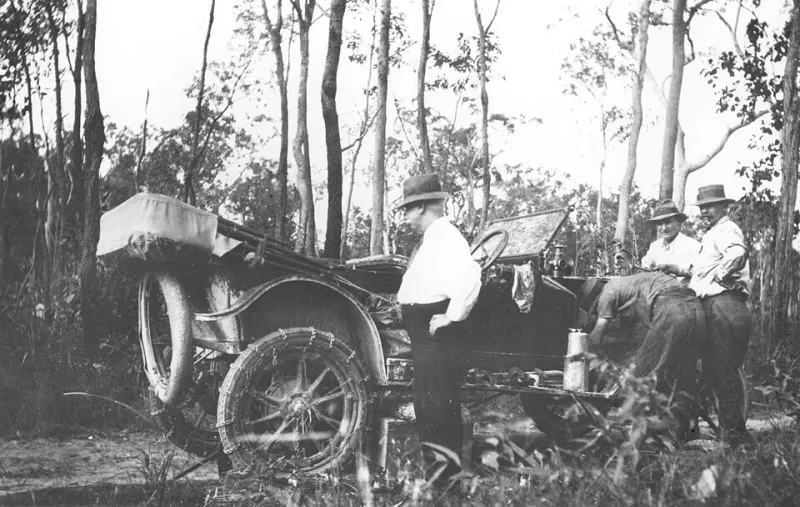
Photo: Queensland State Archives, PDM-owner, via Wikimedia Commons
The American road trip carries an almost mythological weight in this country. It shows up in literature and film as a symbol of freedom, self-discovery, and the open horizon. Jack Kerouac made it poetry. Route 66 made it legend. Millions of Americans have loaded up a car and pointed it somewhere unfamiliar, trusting that the road would take them there.
What almost none of those Americans know is that the confidence to do exactly that — to drive somewhere you've never been and trust that you'll find your way — was handed to ordinary people not by romantics or adventurers, but by a wallpaper salesman trying to make his sales territory more manageable.
The Problem With Early Automobile Travel
In the first decade of the 20th century, owning an automobile was still a relatively new and genuinely risky proposition. The cars themselves were unreliable. The roads were worse. Outside of major cities, American roads in 1905 were largely unpaved, poorly marked, and completely unmapped in any practical sense. There were no gas stations on every corner, no standardized highway numbers, no roadside signs telling you how far it was to the next town.
Getting from one place to another by automobile required either local knowledge, a local guide, or a willingness to get comprehensively lost. For most Americans, the automobile was a vehicle for short, familiar trips — not for venturing into unfamiliar territory. The idea of driving across a state, let alone across the country, felt genuinely daunting in a way that's almost impossible to appreciate from the vantage point of GPS and interstate highways.
Into this landscape came traveling salesmen — and they had a problem.
A Salesman's Frustration Becomes a Map
Nelson Dunning sold wallpaper across the Midwest in the early 1900s, and his job required him to cover an enormous territory by automobile. Every trip into unfamiliar towns meant navigating by vague local directions, unreliable landmarks, and the kind of guesswork that cost time and, more importantly, sales.
Dunning's solution was practical to the point of being mundane: he started writing things down. Routes that worked. Roads that were passable in wet weather. Distances between towns. Shortcuts that actually shortened the trip rather than extending it into a muddy detour. He compiled these notes into rough guides — hand-drawn, utilitarian, and aimed at solving a very specific commercial problem.
He wasn't thinking about adventure. He wasn't imagining a future in which Americans would take vacations by car. He was trying to sell more wallpaper by wasting less time getting lost.
But his guides circulated. Other salesmen found them useful. The information spread, got copied, got refined. And in that circulation, something important happened: the guides stopped being purely professional tools and started becoming something that ordinary people could use.
The Commercial Map Industry Takes Over
Dunning wasn't alone in recognizing the opportunity. By the early 1910s, several commercial interests had noticed that Americans with automobiles were hungry for reliable road information, and that nobody was systematically providing it.
Oil companies saw the opportunity first. Standard Oil and its regional affiliates began producing and distributing free road maps as a promotional tool — give drivers a map, and you give them a reason to travel farther, which means they need more gasoline, which means they stop at more filling stations. The logic was straightforward, and it worked brilliantly. By the 1920s, free maps from oil companies and tire manufacturers were a standard part of American motoring culture.
But those maps were built on a foundation that people like Dunning had helped establish — the basic framework of thinking about American roads as a network that could be documented, organized, and navigated by an ordinary person with a car and a piece of paper.
The American Automobile Association, founded in 1902, also began producing route guides and maps for its members. The Federal Aid Road Act of 1916 and the Federal Highway Act of 1921 pushed the government into systematic road building and, eventually, road numbering. By the mid-1920s, the numbered highway system that would eventually become the US Route network was taking shape.
Each of these developments built on the same basic insight that Dunning's wallpaper routes had demonstrated: that ordinary Americans could navigate unfamiliar roads if someone gave them reliable information.
The Culture That the Map Created
It's worth pausing on what road maps actually did to American culture, because the effect was profound and almost entirely unplanned.
Before reliable maps existed, the automobile was primarily a local machine. You drove it to work, to church, to visit neighbors. The idea of pointing a car at a city three states away and expecting to arrive was not a reasonable middle-class aspiration — it was something only the wealthy or the adventurous attempted.
Maps changed that calculus. A family in Ohio could look at a map, trace a route to Niagara Falls, and reasonably expect to make that trip without hiring a guide or relying on the kindness of strangers for directions. The map transferred knowledge from the local to the universal. It democratized mobility.
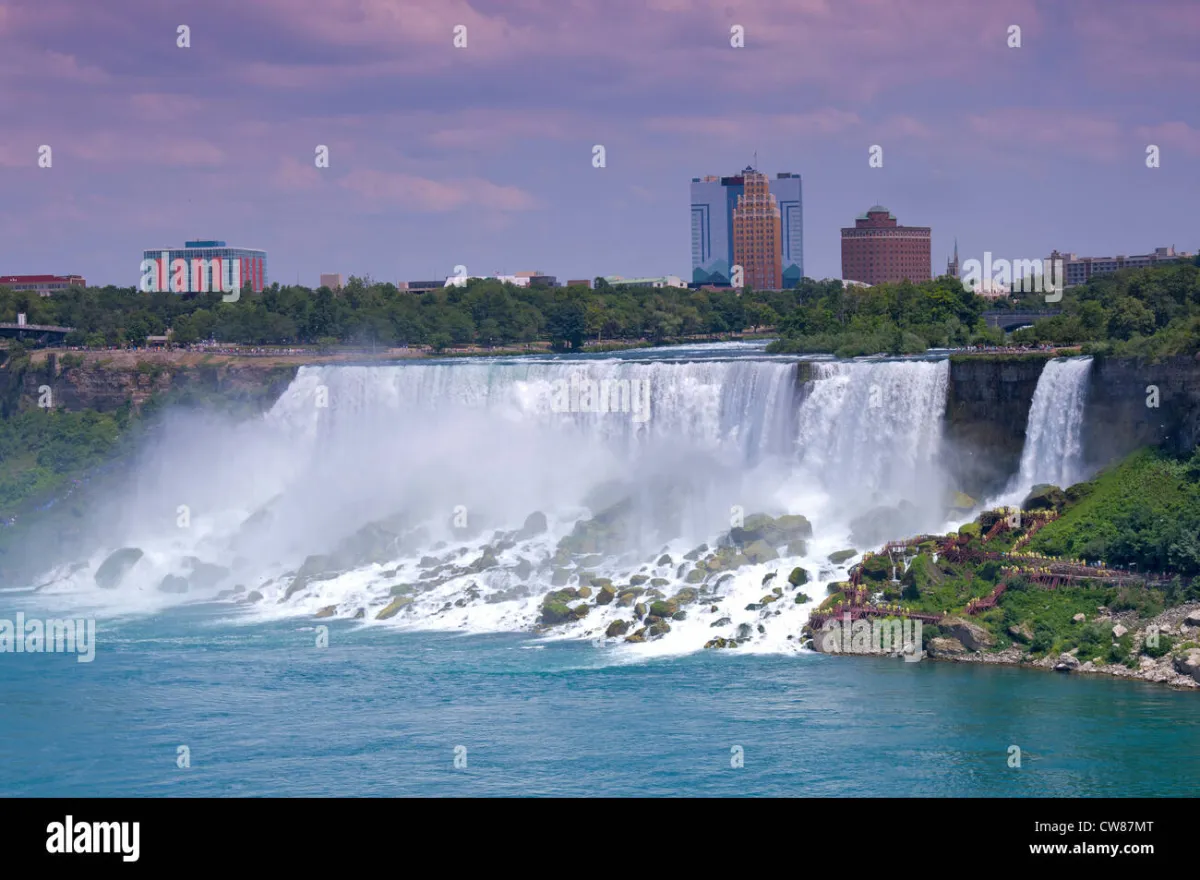 Photo: Niagara Falls, via c8.alamy.com
And once Americans discovered they could drive somewhere unfamiliar and arrive safely, they wanted to do it again. The motel industry emerged to serve road travelers. Roadside diners, tourist attractions, and the entire apparatus of American vacation culture grew up around the expectation that ordinary people would drive long distances for leisure.
All of that — the motels, the diners, the postcards, the family vacation mythology — traces back to the moment when ordinary Americans gained enough confidence in road information to actually use it.
The Wallpaper Was Never the Point
Nelson Dunning presumably sold a reasonable amount of wallpaper over the course of his career. History doesn't record whether he was particularly successful at it. What history does record, in the broader sense, is the shape of what he and people like him accidentally created.
The American road trip isn't really about freedom or self-discovery or the open road as metaphor. At its root, it's about information — the simple, radical idea that someone had bothered to write down which roads went where and how long it took to get there.
A wallpaper salesman needed that information to do his job. An entire country ended up using it to define a national identity.
That's the thing about origin stories: the people who start them are almost never the ones who understand what they've begun.