When Love Hurts: The Kitchen Accident That Revolutionized American First Aid

Every American medicine cabinet tells the same story. Tucked between the aspirin and antiseptic, you'll find a small box of adhesive bandages—those beige strips we slap on everything from paper cuts to playground scrapes. But this everyday essential didn't emerge from a hospital lab or military research facility. It was born from pure marital devotion and a lot of kitchen mishaps.
The Accident-Prone Bride
Earle Dickson had a problem. His new wife, Josephine, seemed magnetically attracted to kitchen disasters. Whether she was slicing vegetables, handling hot pans, or simply existing near sharp objects, she managed to injure herself with remarkable consistency. By 1920, their first year of marriage had become an endless cycle of cuts, burns, and the tedious ritual of wrapping each wound with separate pieces of gauze and adhesive tape.
 Photo: Josephine, via cdn.britannica.com
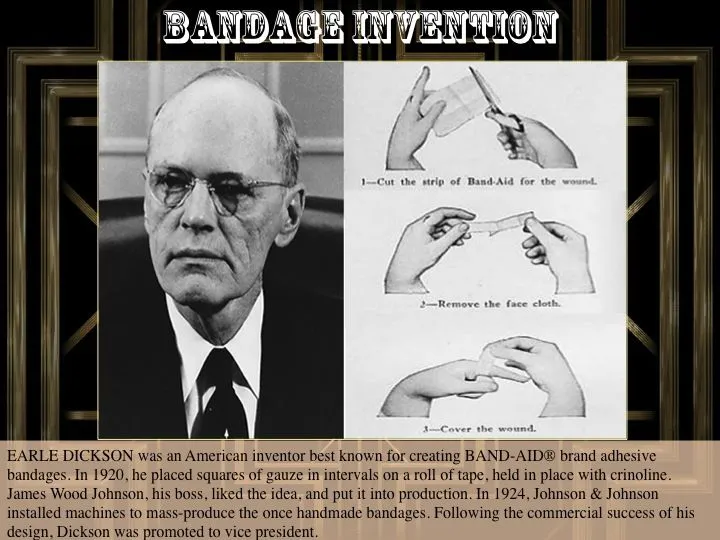 Photo: Earle Dickson, via i.pinimg.com
Dickson worked as a cotton buyer for Johnson & Johnson, so he understood wound care better than most husbands. But the standard first-aid approach was clunky and time-consuming. Each injury required cutting tape to size, positioning gauze precisely, and hoping the whole contraption would stay put. For someone like Josephine, who seemed to collect new injuries faster than old ones could heal, this process was becoming a part-time job.
 Photo: Johnson & Johnson, via 1000logos.net
The Husband's Hack
Frustration breeds innovation, and Dickson's breakthrough came from pure practicality. He started pre-making bandages by placing small squares of gauze in the center of adhesive tape strips, then covering the sticky parts with removable fabric. Now Josephine could handle her own minor emergencies—just peel, stick, and get back to whatever dangerous kitchen activity had claimed her attention.
The homemade solution worked so well that Dickson mentioned it to his supervisors at Johnson & Johnson. The company had been manufacturing surgical supplies since 1886, but they'd never considered pre-made bandages for everyday use. The idea seemed almost too simple.
From Kitchen Table to Corporate Boardroom
Johnson & Johnson's initial enthusiasm quickly hit a wall. The first commercial Band-Aids, launched in 1921, were handmade and expensive. Sales crawled along at roughly $3,000 per year—hardly the breakthrough anyone had hoped for. The product seemed destined for the corporate graveyard of good ideas that couldn't find their market.
But someone at the company had a different vision. Instead of trying to sell Band-Aids to adults who were set in their first-aid ways, they started giving them away to Boy Scout troops across the country. Suddenly, a generation of young Americans was learning that cuts didn't require a complex ritual of tape and gauze. You could just stick on a Band-Aid and keep going.
The Accidental Empire
The Boy Scout strategy worked beyond anyone's wildest projections. Kids went home raving about these magical strips that made boo-boos disappear. Parents started buying them for household use. By 1924, Johnson & Johnson had mechanized production, making Band-Aids cheaper and more widely available.
The timing couldn't have been better. America was becoming more active, more mobile, and more willing to treat minor injuries as temporary inconveniences rather than reasons to slow down. Band-Aids perfectly captured this cultural shift toward quick fixes and getting back to business.
The Cultural Takeover
Within a decade, Band-Aids had become so synonymous with minor wound care that the brand name started replacing the generic term "adhesive bandage" in everyday conversation. This wasn't just market dominance—it was linguistic conquest. When a product becomes a verb ("just Band-Aid it"), you know it has transcended its original purpose to become part of the cultural DNA.
The product's evolution reflected America's changing relationship with injury and healing. Previous generations had treated every cut as a potential medical emergency requiring careful attention and professional-grade supplies. Band-Aids democratized wound care, turning every parent into a capable field medic and every medicine cabinet into a mini emergency room.
The Legacy of Domestic Innovation
Today, Johnson & Johnson sells over 100 billion Band-Aids annually, generating revenues that dwarf entire industries. But the real story isn't about corporate success—it's about how a husband's love for his accident-prone wife accidentally rewrote the rules of American first aid.
Earle Dickson's simple kitchen hack proved that the best innovations often come from the most mundane frustrations. He wasn't trying to revolutionize medicine or build a business empire. He just wanted Josephine to stop bleeding on the dinner preparations. Sometimes the most transformative ideas start with the smallest problems, and sometimes love really is the mother of invention.