The Glue That Wouldn't Hold On Became the Office Supply Nobody Can Live Without
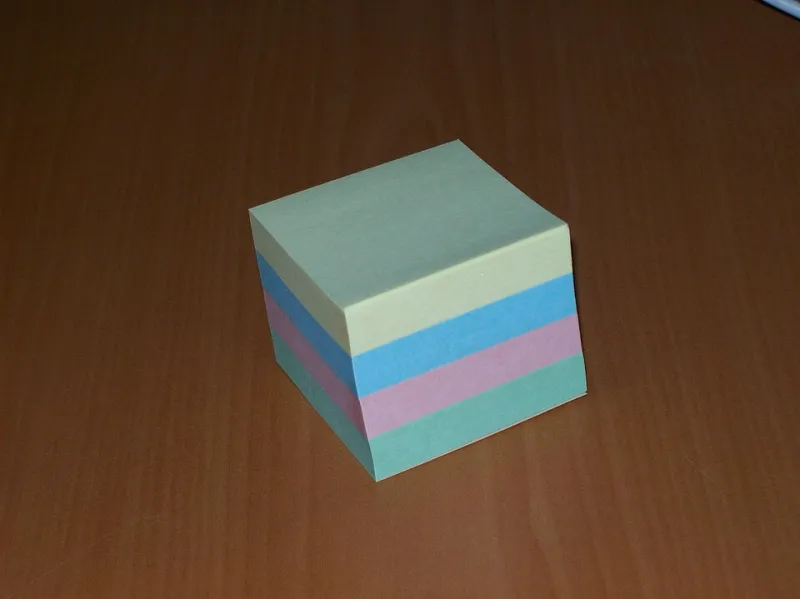
Photo: J.P. C., CC BY-SA 2.0, via Wikimedia Commons
There's a pale yellow square stuck to your monitor right now. Maybe it has a phone number on it. Maybe a grocery list. Maybe just the word "CALL BACK" in capital letters that you've been ignoring for three days. Either way, you've never once stopped to wonder how it got there.
You should. Because the story behind that little square of paper is one of the stranger tales in American business history — a story about a failed experiment, a frustrated church choir singer, and a decade-long battle to convince one of the country's biggest companies that a product that barely worked was actually worth selling.
The Accident in Lab 1 at 3M
In 1968, a chemist named Spencer Silver was working at 3M's research facility in St. Paul, Minnesota. His assignment was ambitious: develop a super-strong adhesive, something that could bond materials together permanently and reliably. The kind of glue that would make other glues jealous.
What he made instead was almost the opposite.
Silver's formula produced tiny acrylic spheres — microscopically small — that stuck to surfaces but never fully bonded with them. Press the material onto paper, and it held. Peel it away, and it came off clean, leaving no residue, ready to be pressed down again somewhere else. It was repositionable, reusable, and thoroughly unimpressive to everyone in the building.
Silver, to his credit, didn't see it as a failure. He genuinely believed the adhesive had potential. For the next several years, he pitched it internally at 3M, holding seminars, writing memos, and advocating loudly for someone — anyone — to find a use for the stuff. The company listened politely. Nobody bit.
Silver's invention was filed away. It might have stayed there forever.
The Choir Singer With a Bookmark Problem
Fast forward to 1974. A 3M colleague named Art Fry had attended one of Silver's seminars years earlier and filed the idea somewhere in the back of his mind. He sang in a church choir in St. Paul, and every Sunday he faced the same minor frustration: the little paper bookmarks he tucked into his hymnal kept falling out at the worst possible moments. Flipping to the wrong page mid-verse. Losing his place entirely.
One Sunday morning, the memory of Silver's strange, weak adhesive surfaced. What if the bookmark stuck just enough to stay put, but not so much that it damaged the page when you pulled it free?
Fry went back to the lab and started experimenting. He coated strips of paper with Silver's adhesive and began testing them. They worked exactly as he imagined. They stayed. They peeled. They left no mark. He started using them to leave notes for his colleagues, sticking them to reports and memos as he passed them around the office.
People started asking where they could get some.
The Company Said No (Twice)
This is where the story gets interesting — and a little maddening.
Fry and Silver brought the product, then called "Press 'n Peel," to 3M's marketing department. The company ran test samples in four cities in 1977. Sales were underwhelming. The feedback was lukewarm. Consumers, when surveyed, said they didn't see the point. 3M's leadership was skeptical that anyone would pay for a notepad that was, by design, temporary.
The product was shelved again.
But a 3M executive named Geoff Nicholson wasn't ready to give up. He and his team tried a different approach. Instead of asking people whether they'd buy the product, they simply gave it to them. In 1978, 3M distributed free samples to office workers in Boise, Idaho — an initiative that became known inside the company as the "Boise Blitz." The results were different this time. Dramatically different. Once people had used the notes, 90 percent said they'd purchase them.
The product was relaunched in 1980 under a new name: Post-it Notes.
From Curiosity to Cultural Institution
Within two years of national launch, Post-it Notes were 3M's best-selling product in the United States. By the early 1990s, the company was producing more than 600 varieties across 100 countries. Today the Post-it brand generates over a billion dollars in annual revenue.
What's remarkable isn't just the commercial success — it's how completely the product rewired office culture. Before Post-it Notes, leaving a message on a colleague's desk meant a handwritten note that could blow away, a paperclip that scratched things, or tape that ruined documents. The repositionable note solved a problem people didn't know they had until they held the solution in their hands.
That's the detail that tends to get lost in the business school version of this story. Spencer Silver didn't invent the Post-it Note. Art Fry didn't either, exactly. What they did was refuse to let a useful accident die — and then put it directly into people's hands until the product made its own case.
The Lesson Stuck
The Post-it Note's origin is sometimes held up as a classic example of innovation-by-accident, and that framing isn't wrong. But the more precise lesson is about persistence in the face of institutional indifference. Silver spent years advocating for an idea that his own company couldn't see the value in. Fry found a personal problem small enough to solve with it. And a smart marketing team eventually figured out that the only way to sell something genuinely new was to stop asking permission and start handing it out.
Next time you peel one off the back of a notepad and stick it to your laptop screen, you're holding the end result of twelve years of someone refusing to throw away a mistake.
Not bad for a glue that didn't work.