How a Boat Shoe Built for Dock Workers Became the Unofficial Footwear of Billionaires
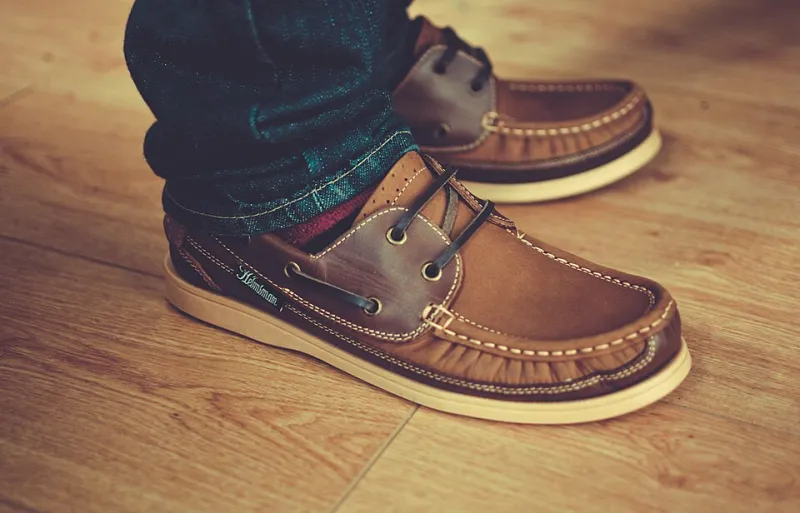
Photo: Alexander Andrews alex_andrews, CC0, via Wikimedia Commons
There's a particular kind of shoe you'll see in a lot of photographs of powerful people. It doesn't have a logo you can read from across the room. It doesn't have a platform or a pointed toe or anything that announces itself. It's usually tan, sometimes navy, occasionally dark brown. It has a distinctive hand-sewn seam running over the toe, small eyelets with rawhide laces, and a rubber sole with a crosshatch pattern cut into it.
If you grew up near the water, you probably know exactly what it is. If you grew up in Silicon Valley, you definitely do.
The boat shoe — and specifically the Sperry Top-Sider, the original version — is one of the more curious status symbols in American fashion history. A shoe designed for physical labor on wet surfaces somehow became the footwear of choice for people who manage money, write code, and give TED talks. Here's how that happened.
A Dog Solved the Problem First
The origin of the boat shoe is genuinely unusual, and it starts not with a fashion designer or a marketing team but with a Connecticut man named Paul Sperry and his cocker spaniel.
Sperry was an avid sailor in the 1930s. Like everyone who spent time on boat decks, he dealt constantly with the problem of traction — wet fiberglass and teak are treacherous surfaces, and conventional leather-soled shoes were nearly useless. Falls were common. Injuries weren't rare.
One winter day in 1935, Sperry watched his dog run across an icy surface without slipping and became curious enough to look at the dog's paw pads up close. What he saw were tiny, irregular cuts — natural siping — that created enough surface friction to grip without reducing flexibility. Sperry went to his workshop, took a knife to a rubber sole, and cut a similar pattern of fine grooves into it.
It worked. The shoe gripped wet surfaces dramatically better than anything available. Sperry filed a patent, started hand-making the shoes in his basement, and eventually sold the concept to a manufacturer. By the late 1930s, Sperry Top-Siders were being sold through marine supply stores along the East Coast.
For the next few decades, that's mostly where they stayed.
The Preppy Pipeline
The boat shoe's first major cultural migration happened through a very specific social channel: the American prep school system.
By the 1950s and 1960s, Sperry Top-Siders had become standard footwear in the sailing communities of New England — which meant they were being worn by the families of old money, the kind that summered on Cape Cod and sent their children to Andover and Exeter. The shoe wasn't fashionable in any deliberate sense. It was simply what people wore when they were near water, which was often.
From prep schools, the shoe moved into Ivy League campuses, where it became part of an informal uniform that also included chinos, oxford shirts, and wool blazers. The 1980 publication of The Official Preppy Handbook — a satirical but oddly accurate guide to upper-crust American style — listed the Top-Sider as an essential item. Sales jumped significantly. The shoe had crossed from functional to cultural.
But the preppy moment of the early 1980s was a peak that eventually faded. By the early 1990s, boat shoes felt dated — too East Coast, too country club, too associated with a particular demographic that younger consumers were actively rejecting. Sales declined. The category drifted.
Enter the Valley
The second cultural migration of the boat shoe is the more interesting one, and it happened largely by accident.
Silicon Valley in the 1990s and early 2000s was developing its own dress code — and that dress code was defined primarily by what it rejected. Suits were for bankers and lawyers, people who worked in hierarchies and worried about appearances. The tech world prided itself on not caring about that stuff. Jeans and a fleece vest became the shorthand for a certain kind of seriousness-without-pretension.
But within that casual framework, a subtler status game was playing out. As tech wealth grew, the people who had it needed ways to signal it that didn't look like they were trying to signal it. Obvious luxury goods — watches, designer suits, flashy cars — were coded as old-economy. What you wanted was something that communicated taste and comfort without appearing to try.
Boat shoes fit that requirement almost perfectly. They were expensive enough to be quality goods but not expensive enough to be ostentatious. They had genuine heritage — a real functional origin, not a marketing story. They didn't have a logo on the side demanding attention. And they were comfortable, which mattered to people who were spending 14-hour days in offices or walking between meetings.
Sperry saw a revival. So did similar shoes — Sebago Docksides, G.H. Bass Weejuns, and eventually the entire "heritage casual" category that lifestyle brands would spend the 2010s mining aggressively.
The Psychology of Quiet Luxury
What the boat shoe story reveals is something worth understanding about how status signals actually work.
For most of the 20th century, American status dressing meant visible markers — brand names you could read, materials you could identify, styles that announced their own expense. That system still operates, but alongside it has grown a parallel language: the language of what fashion writers now call "quiet luxury" or "old money aesthetic."
In that language, the boat shoe is nearly perfect. It says: I have enough money that I don't need to prove I have money. I care about quality but not about fashion. I'm comfortable enough in my own position that I'll wear the same shoe a dock worker wore in 1960.
There's also something specific to tech culture here. The boat shoe, like the fleece vest and the Patagonia jacket, functions as a kind of anti-status status symbol — a way of rejecting the conventions of corporate dress while still participating in a social hierarchy. Wearing a $180 pair of hand-sewn leather moccasins in a venture capital meeting communicates something very different from wearing a $400 dress shoe. Both are expensive. Only one of them is trying to look like it isn't.
From Deck to Desk
Paul Sperry carved grooves into a rubber sole because his dog didn't slip on ice. He wasn't thinking about Sand Hill Road or Series A funding rounds or the aesthetics of wealth-signaling in post-industrial America.
But his shoe — utilitarian, unpretentious, built to solve a physical problem — ended up outlasting dozens of fashion trends precisely because it was never really about fashion. It was about function. And in a culture that increasingly rewards the appearance of not caring about appearances, that turned out to be the most valuable quality a shoe could have.