Life Before the Tyranny of Time
In 1870, if you lived in Pittsburgh and wanted to know the time, you had about twelve different options—and they were all "correct." The courthouse clock might read 12:17, the church bell tower could show 12:23, and the train station might insist it was 12:31. Nobody worried about the discrepancy because nobody needed to.
Most Americans lived by what we'd now call "sun time"—when it got light, you started working; when it got dark, you stopped. Noon was whenever the sun reached its highest point in your particular patch of sky. If you lived ten miles east or west of your neighbor, your noon would be a few minutes different from theirs. This seemed perfectly reasonable to people who rarely traveled faster than a horse could carry them.
Cities kept their own time based on local solar observations. Boston ran about 11 minutes and 45 seconds ahead of New York. Chicago was nearly an hour behind Philadelphia. Buffalo operated on a completely different schedule from Albany, despite being in the same state. America was a patchwork of thousands of local times, each community marching to its own temporal drummer.
When Speed Became Deadly
Then came the railroads, and suddenly the casual approach to timekeeping became a matter of life and death. Trains moved too fast for the old system to work. A locomotive traveling 60 miles per hour could cover the distance between two towns—and their different local times—in minutes. The margin for error that worked fine for horse-drawn carriages became a recipe for disaster.
The wake-up call came in a series of horrific crashes throughout the 1870s and 1880s. On August 12, 1853, two trains collided head-on near Providence, Rhode Island, killing 14 people. The cause? The engineers were operating on different time systems and thought they had more room on the single track than they actually did.
 Photo: Providence, Rhode Island, via thumbs.dreamstime.com
Similar crashes followed with disturbing regularity. The deadliest occurred in 1876 near Ashtabula, Ohio, where 92 people died when a bridge collapsed under a train that was running behind schedule—though "behind schedule" meant different things depending on which town's clock you consulted.
 Photo: Ashtabula, Ohio, via visitashtabulacounty.com
Railroad executives realized they had a problem that couldn't be solved with better brakes or stronger bridges. They needed every train, station, and employee in the country to operate on the same time system. But convincing an entire nation to abandon its local customs for the convenience of train schedules would require more than corporate policy—it would require rewiring how Americans thought about time itself.
The Day America Synchronized
On November 18, 1883, the railroads took matters into their own hands. At exactly noon Eastern time, telegraph operators across the country sent a signal that stopped clocks in hundreds of cities and towns. It was called "The Day of Two Noons," and it marked the moment when America abandoned thousands of years of local timekeeping for the convenience of train schedules.
The railroads divided the country into four time zones—Eastern, Central, Mountain, and Pacific—each exactly one hour apart. The boundaries were drawn not by geography or politics, but by railroad convenience. Some cities found themselves split between zones, with one side of town operating an hour ahead of the other.
The reaction was swift and angry. Newspapers called it "railroad tyranny" and "the death of local democracy." Religious leaders complained that only God should control time. In Indianapolis, angry citizens gathered to ceremonially stop the city's clocks in protest. Some towns simply refused to comply, creating pockets of temporal resistance that lasted for decades.
But the railroads had something more powerful than popular opinion: they had economic necessity. Any city that wanted regular train service had to adopt railroad time. Businesses that dealt with multiple cities needed synchronized schedules. Gradually, reluctantly, America fell into line.
From Luxury to Necessity
Before railroad time, most American homes didn't have clocks. Why would they? If you needed to know the approximate time, you could look at the sun, listen for church bells, or ask a neighbor. Precise timekeeping was a luxury for the wealthy, not a necessity for ordinary families.
The railroads changed that calculation. If you wanted to catch a train, you needed to know exactly when it would arrive. If you worked in a factory that shipped goods by rail, you needed to coordinate with distant suppliers and customers. If you lived in a town connected to the railroad network, you were suddenly part of a vast synchronized machine that demanded punctuality.
Clock manufacturers, who had previously catered to a small market of wealthy customers, suddenly found themselves with an entire nation of potential buyers. Companies like Seth Thomas and Waterbury Clock began mass-producing affordable timepieces designed for ordinary homes. The kitchen wall clock—sturdy, accurate, and cheap enough for working families—became one of the most popular models.
The Moral Transformation of Time
Something deeper than technology was changing. Before the railroads, being late was inconvenient but not immoral. If you showed up to a meeting when the sun was "about overhead" instead of precisely at noon, nobody questioned your character. Time was flexible, approximate, forgiving.
Railroad time made punctuality a virtue and lateness a sin. If you missed your train because you were five minutes late, you might not get another chance until the next day. Suddenly, those extra minutes mattered enormously, and society began to judge people based on their relationship with the clock.
Businessmen who had once operated on "sometime this afternoon" schedules now made appointments for "2:15 sharp." Workers who had started their day "around sunrise" now punched time clocks that recorded their arrival to the minute. Schools that had begun "when the children gathered" now rang bells at precisely scheduled intervals.
The kitchen clock became the enforcer of this new temporal morality. Mothers used it to ensure children left for school on time. Families planned meals around train schedules and factory shifts. The clock that had once been a luxury item became the household's disciplinarian, its steady tick a constant reminder that time was money and lateness was failure.
The Unintended Consequences of Synchronization
The railroads had solved their scheduling problem, but they'd accidentally created something much larger: a synchronized society. Once everyone was operating on the same time system, it became possible to coordinate activities across vast distances in ways that had never been possible before.
Stock markets could open and close simultaneously in different cities. Newspapers could report events with precise timestamps that meant the same thing to readers everywhere. Sports leagues could schedule games that started at the same moment across the continent.
But synchronization came with costs that nobody had anticipated. The relaxed, seasonal rhythms that had governed human life for millennia were replaced by the mechanical precision of railroad schedules. People began to feel enslaved by time rather than served by it. The phrase "time is money" shifted from metaphor to literal truth.
The Clock That Conquered the Kitchen
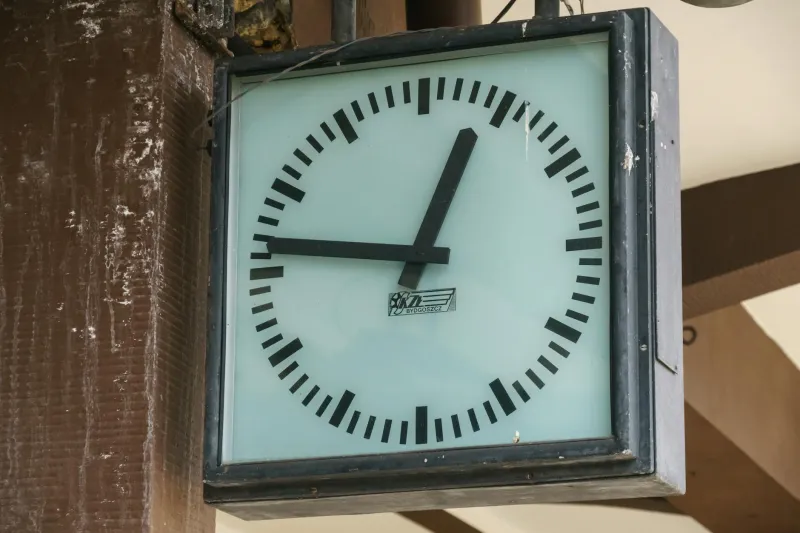
By 1900, most American kitchens had a wall clock, and most Americans had internalized the railroad's temporal discipline. The kitchen clock became the household's command center, coordinating everything from meal times to work schedules to social visits.
It's hard to imagine now, but that innocent-looking timepiece on the kitchen wall represents one of the most dramatic cultural shifts in American history. It marks the moment when natural rhythms gave way to mechanical precision, when local customs surrendered to national standards, when flexibility was sacrificed for efficiency.
The next time you glance at a kitchen clock to see if you're running late, remember: you're participating in a ritual that didn't exist before the 1880s, created not by tradition or necessity, but by the simple need to keep trains from crashing into each other. The tyranny of time that governs modern life began with a practical problem on the railroads and ended up rewiring the American soul, one kitchen clock at a time.