The Ten-Minute Commission
December 1963 was a rough month for State Mutual Life Assurance Company in Worcester, Massachusetts. Employee morale had hit rock bottom after a series of corporate mergers and layoffs. The company's executives decided they needed something—anything—to brighten the office atmosphere.
They called Harvey Ball, a local commercial artist who specialized in quick turnaround jobs. The brief was simple: create something cheerful for buttons and posters. Ball sat down at his desk, grabbed a yellow marker, and in less than ten minutes, sketched a yellow circle with two black dots for eyes and a curved line for a smile.
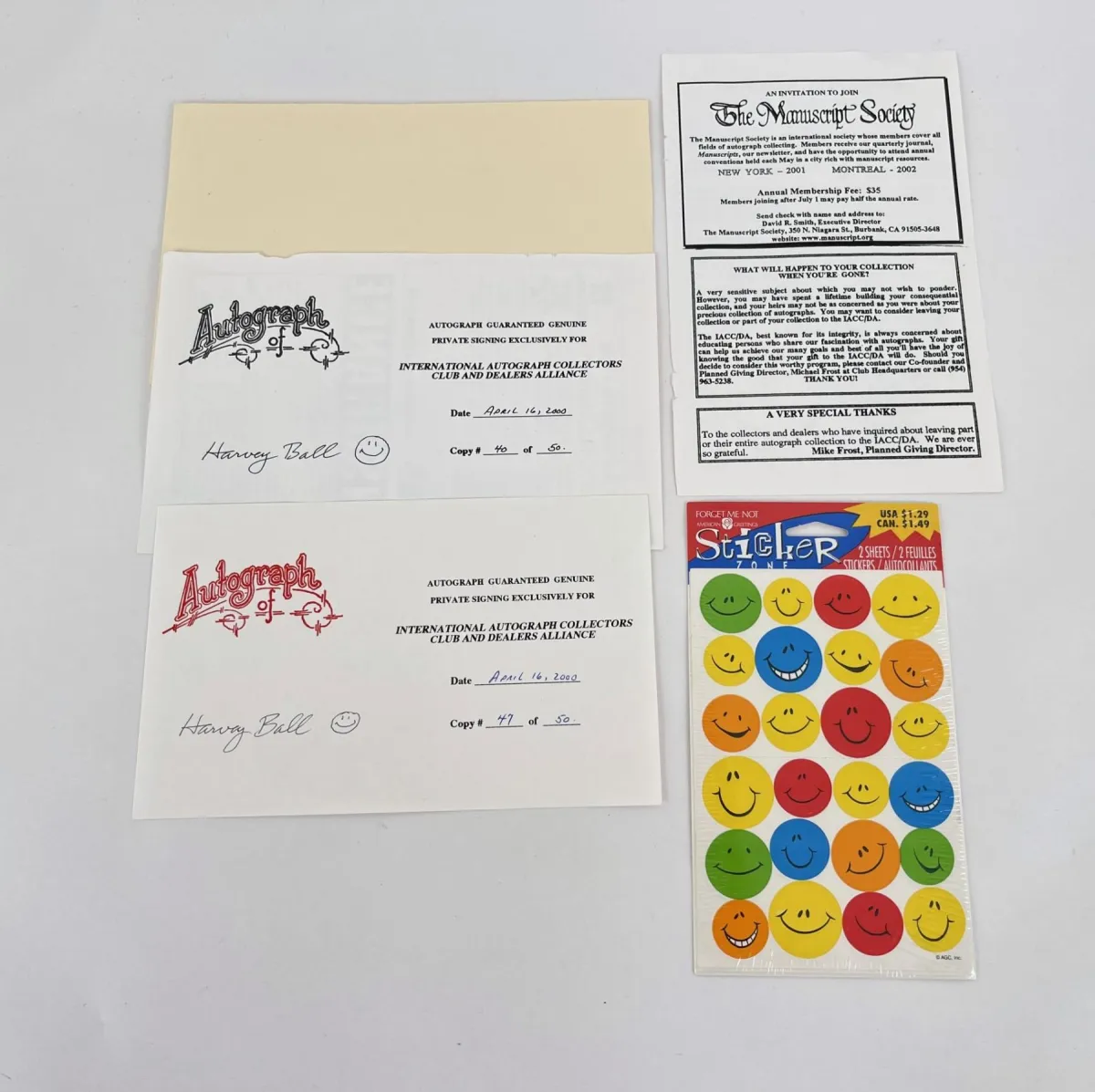 Photo: Harvey Ball, via dygtyjqp7pi0m.cloudfront.net
He handed over the design, collected his $45 fee, and forgot about it. Ball had no idea he'd just created what would become the most reproduced image in human history.
The Button That Started Everything
State Mutual ordered 100 yellow buttons featuring Ball's design and handed them out to employees. The response was immediate and unexpected—people loved them. Within months, the company had ordered thousands more buttons, and employees were taking them home to share with family and friends.
But here's where Ball made a crucial mistake: he never copyrighted the design. In 1963, simple geometric designs like his smiley face were considered too basic for trademark protection. Ball assumed it would remain a small local campaign and never bothered with legal paperwork.
By 1970, the smiley face had escaped Worcester entirely. Novelty companies across America were printing it on everything—t-shirts, bumper stickers, coffee mugs, and more buttons. No one was paying Ball a dime.
The French Connection
Things got complicated in 1971 when French journalist Franklin Loufrani registered the smiley face as a trademark in Europe, claiming he'd invented it for a newspaper campaign. Loufrani built an empire around the symbol, licensing it for products across dozens of countries and eventually earning millions in royalties.
Meanwhile, Philadelphia brothers Bernard and Murray Spain stumbled onto the design while looking for images to put on novelty items. They had no idea who created it, but they started mass-producing smiley face merchandise with the slogan "Have a Happy Day." Their company sold over 50 million buttons in 1972 alone.
Ball watched from Worcester as his ten-minute doodle generated millions in revenue for everyone except him.
The Battle for a Smile
By the 1990s, multiple parties claimed ownership of the smiley face. Loufrani's family insisted they'd invented it in France. The Spain brothers argued they'd popularized it in America. Ball's supporters pointed to his 1963 original as the first documented version.
The legal battles were surreal. Courts had to determine whether a yellow circle with two dots and a curve could be owned by anyone. Expert witnesses testified about the cultural significance of smiling. Lawyers argued over the precise angle of the mouth curve.
In the end, no one won decisively. The design was ruled too simple and ubiquitous for any single party to control completely, though various versions remain trademarked in different countries.
The Artist's Philosophy
Harvey Ball never seemed bitter about missing out on the smiley face fortune. In interviews, he expressed amazement that his simple sketch had brought joy to people worldwide. "I made it as simple as possible," he once said. "It was about the only thing I could think of that couldn't be misconstrued or taken the wrong way."
In 1999, Ball founded World Smile Day, encouraging people to perform acts of kindness. He died in 2001, having seen his creation become a universal symbol of happiness, optimism, and sometimes irony.
 Photo: World Smile Day, via static.vecteezy.com
The Inescapable Icon
Today, the smiley face appears billions of times daily in text messages, emails, and social media posts. It's been adopted by rave culture, grunge music, corporate branding, and political movements. The simple yellow circle has transcended its insurance company origins to become humanity's most basic visual shorthand for positive emotion.
Ball's ten-minute sketch proved something profound about human communication: sometimes the simplest ideas are the most powerful. His $45 doodle became priceless not because it was complex or clever, but because it captured something universal in the most basic way possible.
The smiley face succeeded because Harvey Ball understood what many designers miss—sometimes the best art is the art that gets out of its own way.