The Pants That Wouldn't Quit: How a Miner's Complaint Built an American Icon
The Pants That Wouldn't Quit: How a Miner's Complaint Built an American Icon
There is no garment more American than blue jeans. They've been worn by presidents and prisoners, teenagers and grandparents, Hollywood stars and farmers. They've been banned from schools, barred from restaurants, and burned in protest. They've crossed every class boundary, survived every fashion cycle, and outlasted every trend that was supposed to replace them. And they exist because a group of California gold miners kept tearing their pants pockets.
The Problem in the Pockets
By the early 1870s, the California Gold Rush had been grinding along for more than two decades. The easy surface gold was long gone. What remained was hard, physical labor — digging, hauling, crouching, climbing — and the men doing it were destroying their clothing at a remarkable rate. The particular point of failure was the pocket. Miners stuffed them with tools, ore samples, and equipment, and the stress on the stitching was more than standard work pants could handle. Seams split. Pockets tore away from the fabric entirely. It was a constant, annoying expense.
Levi Strauss had arrived in San Francisco from Bavaria in 1853, initially planning to sell dry goods to the booming population of Gold Rush California. He wasn't a tailor and had no particular interest in fashion. He was a merchant. But in 1872, he received a letter from Jacob Davis, a tailor working in Reno, Nevada, who had come up with a solution to the pocket problem: copper rivets.
Davis had been reinforcing the stress points on his customers' work pants with small metal rivets — the same kind used in horse blankets — and the results were dramatic. The pants held up. The pockets stayed intact. His customers were delighted. The problem, Davis explained in his letter, was that he couldn't afford to patent the idea himself and was worried a competitor would steal it before he could protect it. He proposed a partnership: Strauss would cover the patent costs; Davis would bring the technique.
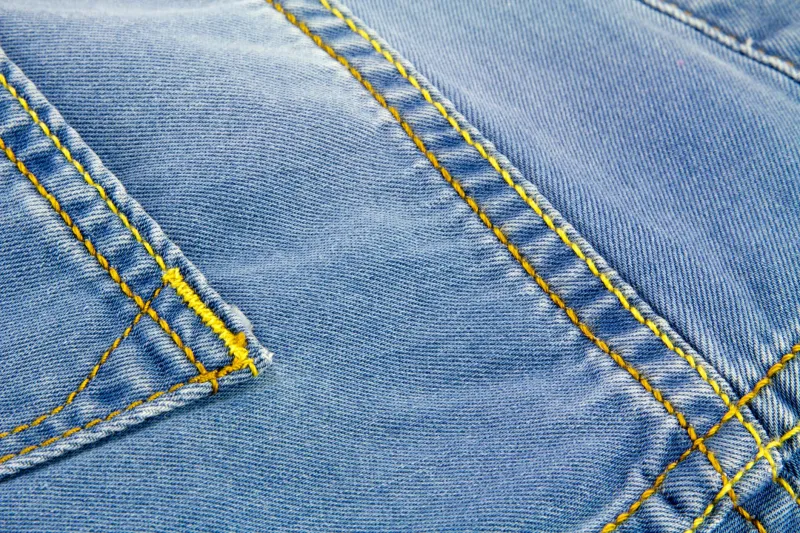
Strauss agreed. On May 20, 1873, the U.S. Patent Office granted patent number 139,121 for "an Improvement in Fastening Pocket-Openings" to Jacob W. Davis and Levi Strauss & Co. The riveted work pant — made from a sturdy cotton denim fabric originally woven in Nîmes, France, and dyed with indigo blue — went into commercial production almost immediately.
Built for Breaking Ground, Not Breaking Hearts
For the first several decades of their existence, Levi's jeans were purely functional. They were sold in hardware stores and dry goods shops, not clothing boutiques. The buyers were laborers — miners, ranchers, railroad workers, and farmers who needed something that would survive the kind of punishment no ordinary trouser could take. The signature copper rivet, the orange stitching, the small red tab that would later appear on the back pocket — these were quality markers, not style choices.
Denim's association with the American West grew steadily through the late 1800s and early 1900s as cowboy culture became romanticized in popular media. Western novels, then early films, dressed their rugged heroes in denim. But the garment still occupied a specific lane: workwear, Western wear, outdoor wear. The idea that someone might wear jeans in a city, by choice, for no practical reason, would have struck most Americans as odd well into the 1930s.
The shift began during World War II. With fabric rationed and practicality prioritized, denim workwear spread beyond its traditional markets. Women working in factories adopted it. Rural styles moved into urban contexts. After the war, returning soldiers — accustomed to utilitarian clothing — brought a more casual sensibility back to everyday American life.
The Rebellion That Wore Denim
What turned blue jeans from workwear into a cultural statement happened in the 1950s, and it happened largely on movie screens.
When Marlon Brando wore jeans in The Wild One in 1953 and James Dean wore them in Rebel Without a Cause in 1955, the garment absorbed something new: attitude. Jeans became the visual shorthand for youth, defiance, and a deliberate rejection of the buttoned-up postwar establishment. They were what you wore when you didn't want to look like your parents.
The backlash was immediate and, in retrospect, completely predictable. Schools across the country banned jeans as inappropriate dress. Restaurants refused entry to customers wearing denim. The garment that Jacob Davis had designed to keep miners' pockets intact was now being treated as a symbol of social disorder.
That association only made jeans more appealing to the generation that came of age in the 1960s. The counterculture adopted them wholesale. Civil rights marchers wore them. Anti-war protesters wore them. Folk singers wore them. Jeans became the uniform of a generation that distrusted authority and wanted their clothing to say so.
From Protest to Uniform
The final stage in jeans' cultural evolution was perhaps the most remarkable: they stopped meaning anything in particular and started meaning everything.
By the 1980s, designer denim had entered the luxury market. By the 1990s, "casual Friday" had made jeans acceptable in offices that would have once required a suit. By the 2000s, they had become so universal that their absence was the unusual choice. The garment that had been banned from schools as a symbol of rebellion was now the default clothing of suburban parents picking their kids up from those same schools.
Levi Strauss & Co. is now a publicly traded company with billions in annual revenue. The original 501 jean — the direct descendant of patent 139,121 — is in the permanent collection of the Smithsonian Institution. A pair of original Levi's from the 1880s sold at auction in 2022 for over $76,000.
Jacob Davis, the tailor who actually invented the rivet, is remembered mostly in footnotes.
And somewhere in the Sierra Nevada foothills, a miner in 1872 complained that his pants kept falling apart — and accidentally set in motion one of the most enduring design stories in American history.